

What Is The Current Racial Makeup Of The United States
46.8 million people in the U.S. identify every bit Blackness
The analysis presented in this report and the accompanying fact sheet well-nigh the Blackness population of the U.s. combines the latest information bachelor from multiple data sources. It is mainly based on information from the U.S. Census Agency's 2006-2019 American Community Surveys (ACS) and the post-obit U.S. decennial censuses provided through the Integrated Public Utilize Microdata Series (IPUMS) from the University of Minnesota: 1900, 1910, 1920, 1930, 1940, 1950, 1960, 1970 (form 2), 1980, 1990 and 2000. The ACS is used to nowadays demographic and economic characteristics for each group.
This data was collected before the COVID-19 pandemic.
This report relies on self-identification of race and ethnicity in U.S. Census Bureau products (decennial censuses and iterations of the American Community Survey) to identify the nation'south Black population. Even so, an private'due south racial and ethnic self-identification may not exist fixed and instead can change over time. In addition, the racial and ethnic categories used by the U.S. Census Agency tin change as the way the nation sees itself changes (meet the "Measuring indigenous and racial identity" section of this study for more details on demography years). These changes may affect how many people identify as Black (or whatever other race).
Unless otherwise noted, adults are those who are ages eighteen and older.
U.Due south. Black population or total Black population refers to all people who self-place every bit Black in the United States. This includes those who say their race is only Black; those who say Black is one of two or more races in their background; and those who say they their race is Black, or that i of their races is Black but also indicate they are of Hispanic or Latino or Black origin. The terms Black population and Blackness people are used interchangeably in this report.
The terms single-race Black and Black lonely are used interchangeably throughout the report to refer to the same population. This population is made up of individuals who self-identify only every bit Black and do not identify equally Hispanic or Latino.
The term multiracial Blackness is used to refer to people who self-identify as two or more races and do not place equally Hispanic or Latino.
The term Blackness Hispanic is used to refer to those who self-identify as Black and Hispanic or Latino, besides as those who self-place equally multiracial Blackness and Hispanic or Latino.
The terms Hispanic or Latino are used interchangeably throughout this report.
White refers to people who self-identify every bit White simply (single race) and do not identify equally Hispanic or Latino.
Asian refers to people who self-place every bit Asian merely (unmarried race) and do non identify as Hispanic or Latino.
U.S. born refers to people who are U.S. citizens at birth, including those born in the United States, Puerto Rico, U.South. territories and those born in other countries to parents at to the lowest degree 1 of whom was a U.S. citizen.
Foreign built-in refers to people built-in exterior of the United States to parents neither of whom was a U.S. citizen. The terms foreign born and immigrant are used interchangeably in this report.
In this report, we refer to several generations. These are defined past their birth years and ages in 2019 as follows:
| Generation | Birth years | Age in 2019 |
|---|---|---|
| Under 7 | 2012-present | 0-vi |
| Generation Z (Gen Z)* | 1997-2012 | seven-22 |
| Millennial | 1981-1996 | 23-38 |
| Generation 10 (Gen Ten) | 1965-1980 | 39-54 |
| Infant Boomer (Boomer) | 1946-1964 | 55-73 |
| Silent | 1928-1945 | 74-91 |
| Greatest | Before 1928 | 92 and older |
The Blackness population of the United States is diverse. Its members have varied histories in the nation – many are descendants of enslaved people, while others are recently arrived immigrants. The Black population too has nuanced ethnic and racial identities reflecting intermarriage and international migration. As a outcome, there are primal distinctions in demographic and economic characteristics between different parts of the national Blackness population, highlighting its diverse multitude of backgrounds.
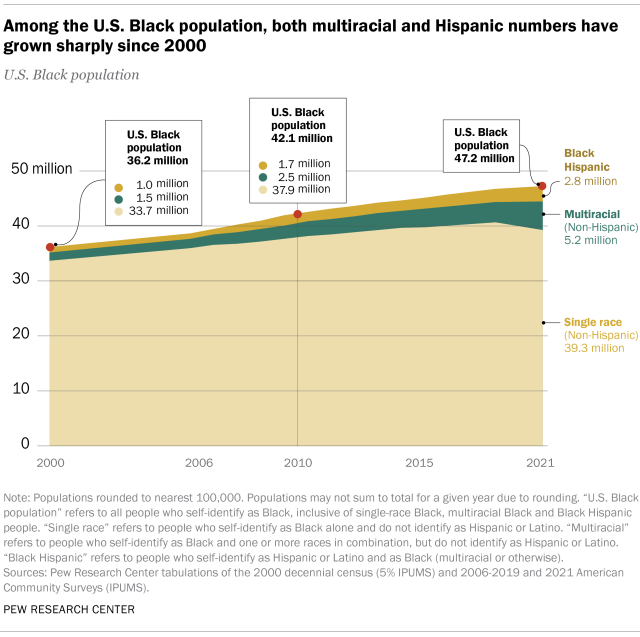
The U.S. Black population is likewise growing. In 2019, 46.8 million people in the U.S. identified their race every bit Blackness, either alone or as part of a multiracial or indigenous background. That is up from 36.ii one thousand thousand in 2000.1 The Black share of the U.Southward. population is higher today than in 2000 as well. Nigh xiv% of the national population said they were Black in 2019, up from xiii% who did so in 2000.
At the same time, the Black population'southward racial self-identification is changing. Among those who self-place equally "Black or African American," the share who say information technology is their only racial or ethnic identification has declined over the past two decades. In 2019, 40.7 million, or 87%, identified their race every bit Black alone and their ethnicity as non-Hispanic, while around 3.7 million, or 8%, indicated their race was Black and another race (nigh oft White) and not Hispanic. Another 2.4 one thousand thousand, or 5%, self-identified every bit both Black and Hispanic, or Black Hispanic.iiBut these shares have inverse since 2000. Then, 93% identified their race and ethnicity as Blackness alone.
The nation'south Black population is changing in other means likewise. A growing share are foreign born, the population is aging (though some segments are significantly younger), and a growing share are college graduates. These trends and more are explored in this report. Accompanying it is a fact sheet showing the demographic and economical characteristics of the nation's Black population in 2019, based on the U.Southward. Census Bureau's 2019 American Community Survey. Findings for all Black people, non-Hispanic single-race Black people, non-Hispanic multiracial Black people and Black Hispanics are shown separately. A downloadable spreadsheet of findings is also bachelor.
Measuring racial and indigenous identity
Racial identity – equally measured by the U.S. decennial census – has changed over time. The census has drastically changed since its first administration in 1790. So, merely two racial categories were included: free (which mostly included White people) and slaves (who were mostly enslaved Black people). The Census Agency has modified terms used to refer to people of non-White racial identities throughout the years, in accordance with the politics and sensibilities of the times. For case, in the 2020 census, those who selected "Black or African American" as their race were asked to write more most their origins, reflecting a more nuanced understanding of Black racial identity. (For more than well-nigh how racial and indigenous categories have changed over fourth dimension, come across "What Census Calls Us.")
Today, decennial census and American Community Survey data is collected in a different manner than for near of the nation's history. Respondents choose their racial response categories themselves. This was not truthful for over a century of censuses. Prior to 1960, 1's racial identification was selected past a demography-taker – a Census Bureau employee who administered the survey on paper and chose a racial category on a person'south behalf. However, starting that twelvemonth, some respondents could self-place, or chose their ain racial category. Self-identification was expanded in subsequent censuses to include virtually all respondents. Additionally, starting in 1980, census data included information from the entire population on Hispanic or Latino ethnic identity in addition to their racial identification.And the 2000 census marked the commencement time respondents were able to include themselves in more than than one racial category; prior to that year, multiracial respondents could select just 1 racial category.
It's important to note that racial and ethnic cocky-identification is highly personal and can change as one's relationship with their identity changes. For example, an analysis of 168 one thousand thousand Americans' demography forms linked between 2000 and 2010 indicated that x million people identified their racial and/or ethnic background differently between the two census forms. Multiracial Americans were one of the population groups that were more likely to change their racial identification between the two decennial census years.
One-in-four Blackness people are members of Gen Z
The age structure of the Blackness population has also changed since 2000. As of 2019, the median age of single-race, not-Hispanic Black people is 35, compared with 30 in 2000. This makes the nation's Black population younger than the nation'due south unmarried-race, non-Hispanic White population (with a median age of 43) and the unmarried-race, not-Hispanic Asian population (38), and slightly older than the nation'south Hispanic population (29).
The median age for the entire Blackness population is 32, though it varies across the differing identities amongst the Black population. Amid Black Hispanic people, it is 22 years. Meanwhile, multiracial Blackness people are the youngest grouping, with a median age of 16.
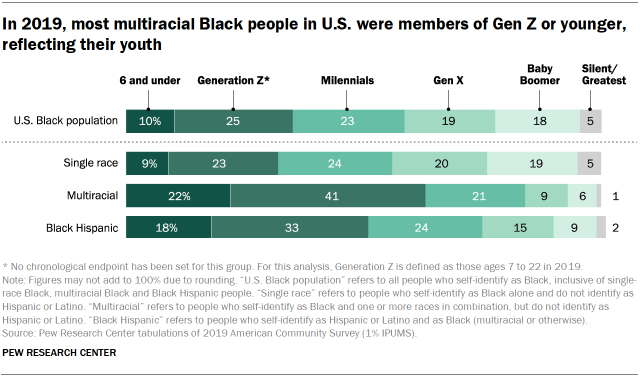
A quarter (25%) of those in the U.S. Black population are members of Generation Z – born betwixt 1997 and 2012 and ages 7 to 22 in 2019. A further one-in-10 were nether the age of seven that year. Together, 35% of the U.Due south. Black population is age 22 or younger. Some other 23% are Millennials, meaning that over half (59%) of the nation's Blackness population were Millennials or younger (under age 38) in 2019.
The majority (63%) of multiracial Black people were age 22 or younger in 2019, reflecting the youth of this demographic subgroup. Roughly half (51%) of Black Hispanics were 22 or younger as well.
Over half of the Blackness population lives in the S
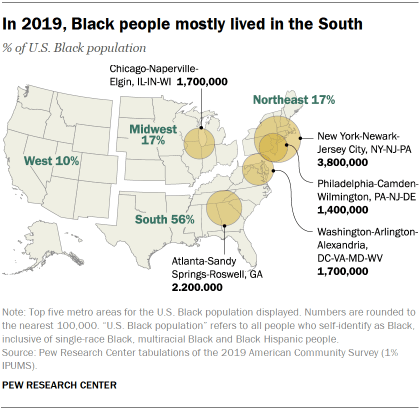
In 2019, the South was the region with the highest share of the country'southward Black population, with 56% of this population living there. The Midwest and Northeast each held 17% of this population, while the West was home to one-tenth of the Blackness population.
Regionally, the share of the national Black population living in the Due south has grown. In 2000, over half (54%) of Black people in the U.S. lived in the Due south, a very similar share to 2019 (56%). Meanwhile, somewhat higher shares lived the Midwest and Northeast in 2000 than in 2019. Back then, xix% of the national Blackness population lived in the Midwest and 18% in the Northeast. Over the past two decades, the share of Blackness people living in Western states was unchanged, at 10%.
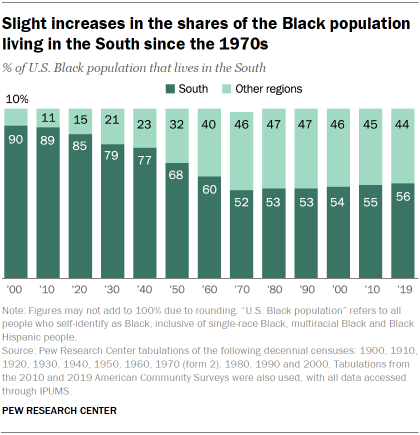
The growth of the Black population in the Southward suggests a departure from previous Blackness migration patterns. The first half of the 20th century featured increasing shares of the population residing in regions of the U.S. outside of the Southward, primarily afterwards the start of the Smashing Migration in the tardily 1910s. Consequently, each decade featured decreasing shares of the Black population living in the South.
Starting in 1970, shares of the Black population who live in the South have grown. At that place has been a 4 percentage point increase in the shares of the Black population who live in the South betwixt 1970 (52%) and 2019 (56%).
Texas has the largest Blackness country population
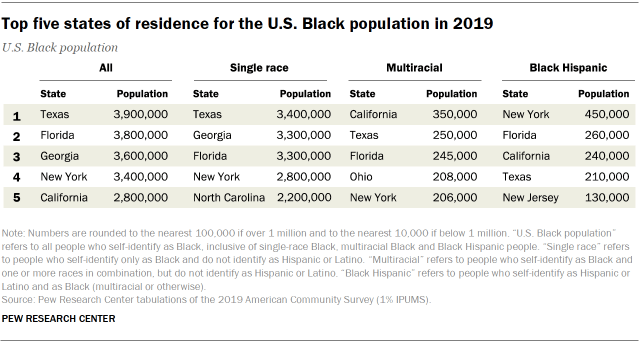
With more than than iii.9 million Blackness people in 2019, Texas is home to the largest Black population in the U.S. Florida has the 2nd largest population at three.viii million, and Georgia is home to 3.6 million Blackness people. Other acme states of residence include New York (3.four million) and California (ii.8 million). Together, these five states hold 37% of the national Black population.
Although the superlative five states of residence have remained the aforementioned for Black people as in 2000, the order shifted substantially, with New York and California dropping from the two largest to quaternary and fifth in 2019. In 2000, New York (iii.2 million), California, Texas, Florida (each 2.5 one thousand thousand) and Georgia (2.iv 1000000) rounded out the top v, together belongings 36% of the total Black population.
Elevation states of residence differ past racial subgroup. Among non-Hispanic single-race Blackness people, Texas has the largest population, followed by Georgia, Florida, New York and North Carolina. But among non-Hispanic multiracial Black people, the state with the largest population is California, followed by Texas, Florida, Ohio and New York. Among Black Hispanics, meanwhile, New York has the largest population, followed by Florida, California, Texas and New Bailiwick of jersey. Notably, Texas, New York and Florida brand the top five for all subgroups.
The New York metropolitan area has the largest Black metropolitan population
The metropolitan expanse with greatest number of Blackness people is the New York metropolitan expanse, with roughly 3.8 million in 2019. The New York City surface area has been the top metropolis since at least 2000 for Black people, though other metro areas are on the rise. In 2019, the Atlanta metropolitan area came in a distant 2d, with 2.2 meg Black people, and the Washington, D.C., area was next, with 1.7 million. By comparison, in 2000, the Chicago metropolitan expanse had the 2nd largest Black metro population and Atlanta had the fourth largest.
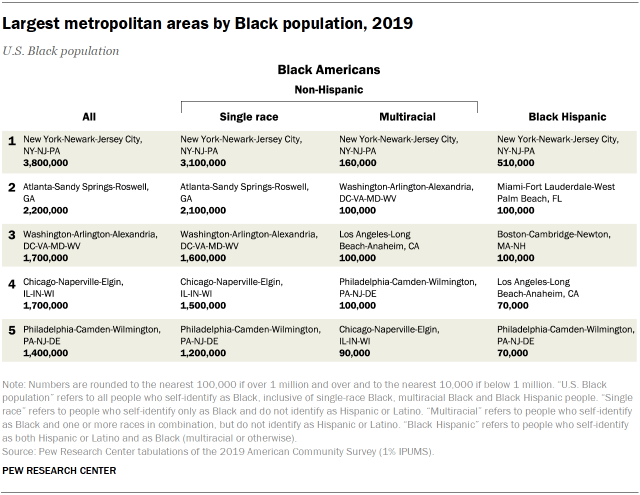
The New York City metropolitan area has the largest Black population across the three Black racial and ethnic subgroups, but the other summit large metropolitan areas differ beyond categories. The list of meridian five metropolitan areas for those who say their racial identity is only Blackness is the same equally information technology is for the Black population overall, reflecting their bulk (87%) share of the population. However, the peak metropolitan areas for multiracial Blackness people and Blackness Hispanics differ.
Likewise New York City, the top urban centers for those identifying every bit multiracial Black are the Washington, D.C., Los Angeles, Philadelphia and Chicago metropolitan areas. Past contrast, for Black Hispanics, Miami is second, followed by the Boston, Los Angeles and Philadelphia metro areas.
The number of Blackness adults with a college caste or more instruction has more than doubled since 2000. That twelvemonth, roughly 3 million Black adults ages 25 and older, or 15%, had earned at least a bachelor's caste. That number grew to half dozen.vii million (23%) in 2019.
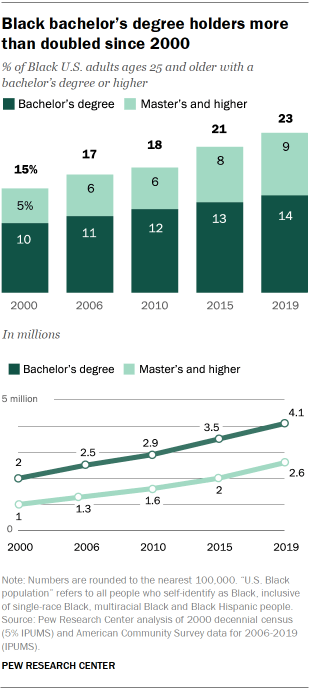
Notably, the share of the Blackness population with at least a college degree has risen at a similar rate to that of the full general population. In 2000, roughly a quarter (24%) of the unabridged U.S. population ages 25 and older had a bachelor's caste or higher. In 2019, that share rose to 33%, an increment of 9 pct points. The share of Black adults who earned a bachelor'due south degree or higher likewise grew nearly nine points over the same fourth dimension menstruation, from xv% to 23%.
There has been a similar upward tendency specifically amidst Black adults with a primary's degree or higher. While roughly 1 million Black adults in 2000 (five% of the population over 25) had an avant-garde caste, that number rose to nigh ii.6 million, or 9% in 2019.
There were differences in educational attainment in 2019 amid unlike subgroups of the Blackness population. Among these groups, the multiracial Black population has the highest shares of adults 25 and older with a bachelor's degree (20%) and advanced degree (12%). Single-race Black adults and Blackness Hispanics 25 and older accept similar, but lower, shares with a bachelor'south degree (xiv% and 15%, respectively) likewise equally an advanced degree (9% and 8%).
The share of Black adults 25 and older without a high school diploma (or its equivalent, such as a GED certificate) has dropped substantially – by more than half – since 2000. Then, roughly three-in-x adults in that age range (28%) had not earned a high school diploma. In 2019, that share had dropped to 13%, signifying a 15 percentage bespeak drop over almost 2 decades.
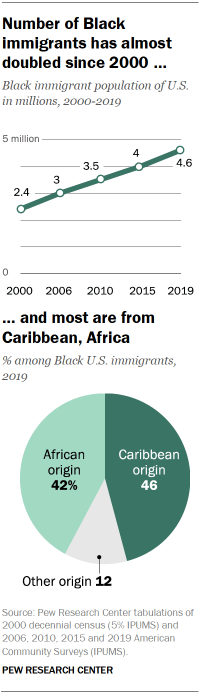
Immigrants are a part of the nation'due south Blackness population that has grown over fourth dimension. The foreign-born Black population has nearly doubled since 2000, rising from 7% so to 10% in 2019. In numbers, ii.iv million Black people were born in some other land in 2000, and past 2019, that had risen to 4.6 million.
Black immigrants are by and large from just 2 regions of the world. Nearly nine-in-ten (88%) were born in African or Caribbean countries. Of that group, a little less than one-half (46%) were born in Caribbean nations, while a slightly lower share (42%) are from African countries. The remaining 12% of Blackness immigrants are from other parts of the world, with Guyana, United mexican states and Honduras as the top 3 countries of origin.
The majority of Black immigrants identify as unmarried-race Black (87%) and non-Hispanic, while ten% identify as Black and Hispanic and 3% say their racial background is multiracial.
Blackness household incomes since 2000
Since 2000, the U.S. Blackness population has not seen significant increases in median household income. The median income for households headed by a Black person was $44,000 in 2019 (before the COVID-nineteen pandemic-induced recession). But household income of Black households varies. Roughly three-in-10 Black households (29%) fabricated less than $25,000 in 2019, while a quarter earned between $25,000 and $49,999 – which means that more than half (54%) of Black households fabricated less than $50,000 in 2019. About one-in-half-dozen Blackness households (17%) made $fifty,000 but below $75,000, x% earned at least $75,000 but less than $100,000, and eighteen% earned $100,000 or more in 2019.
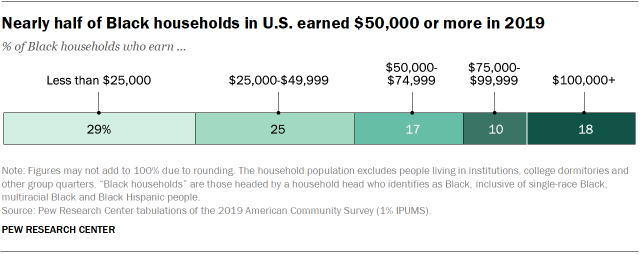
The 2019 shares represent an improvement over the distribution of Black household income in 2000. In 2000, roughly 3-in-ten (31%) Black-headed households fabricated $25,000 or less (in 2019 U.S. dollar adjusted value), and a quarter (25%) made between $25,000 and $49,999, meaning that 56% of Black households earned less than $50,000 in 2000. In that same year, roughly 3-in-ten Blackness households (28%) made at least $50,000 just less than $100,000, and 16% made $100,000 or more.
The median income among Black households in 2019 was roughly $44,000, representing a slight inflation-adjusted increase over the median household income for Blackness people in 2000 ($43,581 afterward adjusting for inflation).
Income inequality within the Blackness population remains 1 of the widest within a major racial or ethnic group. In 2019, Black-headed households with income in the 90th percentile among the population of Black households earned 14 times that of Blackness households with income in the tenth percentile. The 90th percentile of households in the overall 2019 population, past dissimilarity, earned 12 times that of households with incomes in the 10th percentile.
CORRECTION (Aug. 4, 2021): The "Black household incomes" section has been updated to reverberate the 2019 inflation-adapted distribution of Black household incomes in 2000, which was mischaracterized in a previous version. Related changes accept been made to whatever references in the text of the study. These changes do not substantively affect the report'due south findings.

What Is The Current Racial Makeup Of The United States,
Source: https://www.pewresearch.org/social-trends/2021/03/25/the-growing-diversity-of-black-america/
Posted by: smithyeterfer.blogspot.com
0 Response to "What Is The Current Racial Makeup Of The United States"
Post a Comment