

How To Create Dictionary In Dictionary Python
Dictionary in Python is an unordered collection of data values, used to store data values like a map, which, unlike other Data Types that hold only a single value as an element, Dictionary holds key:value pair. Key-value is provided in the dictionary to make it more optimized.
Note – Keys in a dictionary don't allow Polymorphism.
Attention geek! Strengthen your foundations with the Python Programming Foundation Course and learn the basics.
To begin with, your interview preparations Enhance your Data Structures concepts with the Python DS Course. And to begin with your Machine Learning Journey, join the Machine Learning - Basic Level Course
Disclamer: It is important to note that Dictionaries have been modified to maintain insertion order with the release of Python 3.7, so they are now ordered collection of data values.
Creating a Dictionary
In Python, a Dictionary can be created by placing a sequence of elements within curly {} braces, separated by 'comma'. Dictionary holds pairs of values, one being the Key and the other corresponding pair element being its Key:value. Values in a dictionary can be of any data type and can be duplicated, whereas keys can't be repeated and must be immutable.
Note – Dictionary keys are case sensitive, the same name but different cases of Key will be treated distinctly.
Python3
Dict = { 1 : 'Geeks' , 2 : 'For' , 3 : 'Geeks' }
print ( "\nDictionary with the use of Integer Keys: " )
print ( Dict )
Dict = { 'Name' : 'Geeks' , 1 : [ 1 , 2 , 3 , 4 ]}
print ( "\nDictionary with the use of Mixed Keys: " )
print ( Dict )
Output:
Dictionary with the use of Integer Keys: {1: 'Geeks', 2: 'For', 3: 'Geeks'} Dictionary with the use of Mixed Keys: {1: [1, 2, 3, 4], 'Name': 'Geeks'} Dictionary can also be created by the built-in function dict(). An empty dictionary can be created by just placing to curly braces{}.
Python3
Dict = {}
print ( "Empty Dictionary: " )
print ( Dict )
Dict = dict ({ 1 : 'Geeks' , 2 : 'For' , 3 : 'Geeks' })
print ( "\nDictionary with the use of dict(): " )
print ( Dict )
Dict = dict ([( 1 , 'Geeks' ), ( 2 , 'For' )])
print ( "\nDictionary with each item as a pair: " )
print ( Dict )
Output:
Empty Dictionary: {} Dictionary with the use of dict(): {1: 'Geeks', 2: 'For', 3: 'Geeks'} Dictionary with each item as a pair: {1: 'Geeks', 2: 'For'} Nested Dictionary:
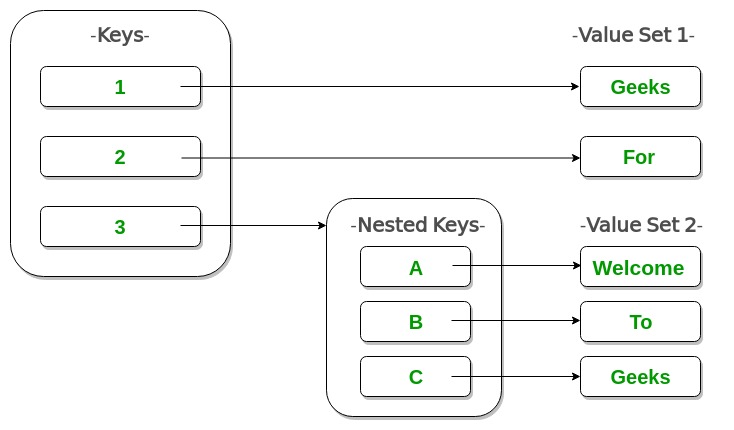
Python3
Dict = { 1 : 'Geeks' , 2 : 'For' ,
3 :{ 'A' : 'Welcome' , 'B' : 'To' , 'C' : 'Geeks' }}
print ( Dict )
Output:
{1: 'Geeks', 2: 'For', 3: {'A': 'Welcome', 'B': 'To', 'C': 'Geeks'}} Adding elements to a Dictionary
In Python Dictionary, the Addition of elements can be done in multiple ways. One value at a time can be added to a Dictionary by defining value along with the key e.g. Dict[Key] = 'Value'. Updating an existing value in a Dictionary can be done by using the built-in update() method. Nested key values can also be added to an existing Dictionary.
Note- While adding a value, if the key-value already exists, the value gets updated otherwise a new Key with the value is added to the Dictionary.
Python3
Dict = {}
print ( "Empty Dictionary: " )
print ( Dict )
Dict [ 0 ] = 'Geeks'
Dict [ 2 ] = 'For'
Dict [ 3 ] = 1
print ( "\nDictionary after adding 3 elements: " )
print ( Dict )
Dict [ 'Value_set' ] = 2 , 3 , 4
print ( "\nDictionary after adding 3 elements: " )
print ( Dict )
Dict [ 2 ] = 'Welcome'
print ( "\nUpdated key value: " )
print ( Dict )
Dict [ 5 ] = { 'Nested' :{ '1' : 'Life' , '2' : 'Geeks' }}
print ( "\nAdding a Nested Key: " )
print ( Dict )
Output:
Empty Dictionary: {} Dictionary after adding 3 elements: {0: 'Geeks', 2: 'For', 3: 1} Dictionary after adding 3 elements: {0: 'Geeks', 2: 'For', 3: 1, 'Value_set': (2, 3, 4)} Updated key value: {0: 'Geeks', 2: 'Welcome', 3: 1, 'Value_set': (2, 3, 4)} Adding a Nested Key: {0: 'Geeks', 2: 'Welcome', 3: 1, 5: {'Nested': {'1': 'Life', '2': 'Geeks'}}, 'Value_set': (2, 3, 4)} Accessing elements from a Dictionary
In order to access the items of a dictionary refer to its key name. Key can be used inside square brackets.
Python3
Dict = { 1 : 'Geeks' , 'name' : 'For' , 3 : 'Geeks' }
print ( "Accessing a element using key:" )
print ( Dict [ 'name' ])
print ( "Accessing a element using key:" )
print ( Dict [ 1 ])
Output:
Accessing a element using key: For Accessing a element using key: Geeks
There is also a method called get() that will also help in accessing the element from a dictionary.
Python3
Dict = { 1 : 'Geeks' , 'name' : 'For' , 3 : 'Geeks' }
print ( "Accessing a element using get:" )
print ( Dict .get( 3 ))
Output:
Accessing a element using get: Geeks
Accessing an element of a nested dictionary
In order to access the value of any key in the nested dictionary, use indexing [] syntax.
Python3
Dict = { 'Dict1' : { 1 : 'Geeks' },
'Dict2' : { 'Name' : 'For' }}
print ( Dict [ 'Dict1' ])
print ( Dict [ 'Dict1' ][ 1 ])
print ( Dict [ 'Dict2' ][ 'Name' ])
Output:
{1: 'Geeks'} Geeks For Removing Elements from Dictionary
Using del keyword
In Python Dictionary, deletion of keys can be done by using the del keyword. Using the del keyword, specific values from a dictionary as well as the whole dictionary can be deleted. Items in a Nested dictionary can also be deleted by using the del keyword and providing a specific nested key and particular key to be deleted from that nested Dictionary.
Note: The del Dict will delete the entire dictionary and hence printing it after deletion will raise an Error.
Python3
Dict = { 5 : 'Welcome' , 6 : 'To' , 7 : 'Geeks' ,
'A' : { 1 : 'Geeks' , 2 : 'For' , 3 : 'Geeks' },
'B' : { 1 : 'Geeks' , 2 : 'Life' }}
print ( "Initial Dictionary: " )
print ( Dict )
del Dict [ 6 ]
print ( "\nDeleting a specific key: " )
print ( Dict )
del Dict [ 'A' ][ 2 ]
print ( "\nDeleting a key from Nested Dictionary: " )
print ( Dict )
Output:
Initial Dictionary: {'A': {1: 'Geeks', 2: 'For', 3: 'Geeks'}, 'B': {1: 'Geeks', 2: 'Life'}, 5: 'Welcome', 6: 'To', 7: 'Geeks'} Deleting a specific key: {'A': {1: 'Geeks', 2: 'For', 3: 'Geeks'}, 'B': {1: 'Geeks', 2: 'Life'}, 5: 'Welcome', 7: 'Geeks'} Deleting a key from Nested Dictionary: {'A': {1: 'Geeks', 3: 'Geeks'}, 'B': {1: 'Geeks', 2: 'Life'}, 5: 'Welcome', 7: 'Geeks'} Using pop() method
Pop() method is used to return and delete the value of the key specified.
Python3
Dict = { 1 : 'Geeks' , 'name' : 'For' , 3 : 'Geeks' }
pop_ele = Dict .pop( 1 )
print ( '\nDictionary after deletion: ' + str ( Dict ))
print ( 'Value associated to poped key is: ' + str (pop_ele))
Output:
Dictionary after deletion: {3: 'Geeks', 'name': 'For'} Value associated to poped key is: Geeks Using popitem() method
The popitem() returns and removes an arbitrary element (key, value) pair from the dictionary.
Python3
Dict = { 1 : 'Geeks' , 'name' : 'For' , 3 : 'Geeks' }
pop_ele = Dict .popitem()
print ( "\nDictionary after deletion: " + str ( Dict ))
print ( "The arbitrary pair returned is: " + str (pop_ele))
Output:
Dictionary after deletion: {3: 'Geeks', 'name': 'For'} The arbitrary pair returned is: (1, 'Geeks') Using clear() method
All the items from a dictionary can be deleted at once by using clear() method.
Python3
Dict = { 1 : 'Geeks' , 'name' : 'For' , 3 : 'Geeks' }
Dict .clear()
print ( "\nDeleting Entire Dictionary: " )
print ( Dict )
Output:
Deleting Entire Dictionary: {} Dictionary Methods
| Methods | Description |
|---|---|
| copy() | They copy() method returns a shallow copy of the dictionary. |
| clear() | The clear() method removes all items from the dictionary. |
| pop() | Removes and returns an element from a dictionary having the given key. |
| popitem() | Removes the arbitrary key-value pair from the dictionary and returns it as tuple. |
| get() | It is a conventional method to access a value for a key. |
| dictionary_name.values() | returns a list of all the values available in a given dictionary. |
| str() | Produces a printable string representation of a dictionary. |
| update() | Adds dictionary dict2's key-values pairs to dict |
| setdefault() | Set dict[key]=default if key is not already in dict |
| keys() | Returns list of dictionary dict's keys |
| items() | Returns a list of dict's (key, value) tuple pairs |
| has_key() | Returns true if key in dictionary dict, false otherwise |
| fromkeys() | Create a new dictionary with keys from seq and values set to value. |
| type() | Returns the type of the passed variable. |
| cmp() | Compares elements of both dict. |
Recent Articles on Python Dictionary
https://youtu.be/z7z_e5
More Videos on Python Dictionary:
Python Dictionary Set 2
Python Dictionary Set 3
Dictionary Programs
- Dictionary Methods – Set 1,Set 2
- Get() method for dictionaries
- Handling missing keys of dictionary
- Ordered Dictionary
- orderDict()
- Chainmap
- Majority Element
- Dictionary and counter in Python to find winner of election
- How to implement Dictionary with Python3
- Possible Words using given characters in Python
- Python dictionary, set and counter to check if frequencies can become same
- Python dictionary intersection
- OrderedDict() in Python
- Check if binary representations of two numbers are anagram
- Python Counter to find the size of largest subset of anagram words
- Print anagrams together in Python using List and Dictionary
- Convert a list of Tuples into Dictionary
- Find all duplicate characters in string
- Remove all duplicates words from a given sentence
- Python Dictionary to find mirror characters in a string
- Python counter and dictionary intersection example (Make a string using deletion and rearrangement)
- Second most repeated word in a sequence in Python
- Python Dictionary Comprehension
- K'th Non-repeating Character in Python using List Comprehension and OrderedDict
- Scraping And Finding Ordered Words In A Dictionary using Python
- Ways to sort list of dictionaries by values in Python – Using itemgetter
- Merging two Dictionaries
Useful Links
- Recent Articles on Python Dictionary
- Output of Python programs – Dictionary
- Output of Python programs – Dictionary
- Coding Practice Platform
- Multiple Choice Questions – Python
- All articles in Python Category
How To Create Dictionary In Dictionary Python
Source: https://www.geeksforgeeks.org/python-dictionary/
Posted by: smithyeterfer.blogspot.com
0 Response to "How To Create Dictionary In Dictionary Python"
Post a Comment